Wednesday, July 11, 2012

#165: Moby - Play (1999)


Emily: Starting out, I was impressed by this album. Moby has a reputation for making ambient electronic music that would probably be played on an elevator, so I had fairly low expectations. The first few songs blew those expectations away. He made his signature sound cool and interesting by incorporating folk and soul samples with electronic production, modernizing the samples and giving roots to a newer sound. However, this unique blend only lasted through the first half of Play. At an hour runtime, I guess Moby just got bored with sampling and went back to his old, ambient ways. The second half of the album was essentially just dull background music, and I lost all of the excitement I had about the beginning tracks. Play would be great if Moby simply chopped off the second half; instead, it ambles into disappointment.
Favorite Tracks: South Side; Honey; Natural Blues

Zack: It was the best of times. It was the worst of times. I start this way because this is a tale of two albums. The first half was exciting. Cool. Enjoyable even. And then we got to the second half, where things went downhill quickly. Basically, after Natural Blues, Play turned into exactly what I expected from a Moby album. Now I’m not sure if that is because the shtick just wore thin, but I don’t think so. To make sure my ears were not deceiving me, I went back and re-listened to that first half. It was still good. There’s just something about that second half that had my finger hovering by the stop button. So my advice for any would-be listeners out there, treat Play less like an hour long LP and more like a really long (30 minute) EP. It’ll save 30 minutes of your life.
Favorite Tracks: Natural Blues; Porcelain; South Side

Tuesday, July 10, 2012

#164: Leonard Cohen - Songs of Love and Hate (1971)


Emily: This album reminded me very much of Jeff Buckley’s Grace. Yes, I know that Songs of Love and Hate was released 20 years before Grace, but that is the folly of listening to this list out of order. Cohen’s beautifully dark, minimalist style on this album definitely paved the way for the haunting beauty of Grace. The comparison gets even stronger with the fact that Hallelujah, an iconic recording by Buckley, was first written and recorded by Cohen (albeit not on this album). Songs of Love and Hate is true to its name, full of acoustic, lyrical songs that focus on the dichotomy of these two emotional states of being. Each song is certainly filled with emotion – some are sad or wistful, while others are angry and haunting. There is no doubt, however, that they are all beautifully written and arranged. This album deserves multiple listens to fully explore the depth of the words and emotions, a task I will happily oblige.
Favorite Tracks: Dress Rehearsal Rag; Famous Blue Raincoat; Avalanche

Zack: Having listened to exactly one Leonard Cohen album, I feel pretty safe in saying that he writes songs solely to confuse people. I’ve listened to this album twice now and still am not sure what more than half the lyrics mean. At one point he mentions looking at a girl like she’s the nervous person at an orgy. Look I’ve been to more than my share of orgies and I have to say that nobody wants to be the newbie. That’s some of the best advice I ever got from my mentor, The Great Orgini. At another point he describes a woman as “waving a Nazi dagger.” Here, I don’t think he went into enough detail. Is the woman a Nazi who possesses a dagger, has she stolen the dagger from a Nazi, or is this a dagger made for the express purpose of killing Nazis (read: Nahtzeees)? You can’t leave me hanging like that, Leonard Cohen! But I will say that the album does live up to its title, especially in the middle. First there’s Diamonds in the Mine, which I believe held the record for angriest country-inspired song until that Boot in Your Ass song wrestled the trophy away over a decade ago. That is immediately followed by Love Calls You By Your Name, which is exactly as mushy as you imagine. The rest of the album is sort of hard to follow content-wise, but solid throughout. Except he does seem to have a thing for Joan of Arc. Still working on decoding that.
Favorite Tracks: Sing Another Sing, Boys; Avalanche; Diamonds in the Mine

Monday, July 9, 2012

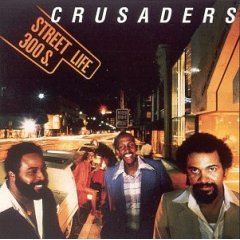
#163: The Crusaders - Street Life (1979)


Emily: Before I turned on Street Life, I had no idea what The Crusaders would be like. That name is so generic it could be anything – rock, punk, country, 12th-century-Christian…the possibilities are endless. What I got, however, was some pretty cool soul-and-funk-influenced jazz from the ‘70s. The 11-minute-long title track, with soulful vocals and modern jazz instrumentals, was simply great, and the other jazzy tracks weren’t so bad either. While jazz isn’t always as exciting to me as other genres, I definitely enjoyed my 40 soulful minutes with The Crusaders.
Favorite Tracks: Street Life; Rodeo Drive (High Steppin’); Carnival of the Night

Zack: Oh the many types of jazz. There’s vocal jazz, cool jazz, bebop, orchestral jazz, latin jazz, soul jazz, free jazz, swing, even something called punk jazz that I am incredible excited to become a fan of sometime in the future. The list goes on and on. I like vocal jazz a lot, so I got very excited with the first and title track off this album. It wasn’t lyrics that’ll change your life or anything like that, but it was words that matched up with the intenseness of the backing jazz. Those were the only words I heard for the next 28 minutes (with the notable exception of my brother’s “hey this is kind of good”). And it was kind of good, words or no words. There was just so much soul to it. That’s probably why Wikipedia describes it as “jazz-funk.” That’s also probably why both Burt Reynolds and Quentin Tarantino chose to include it in movies they were directing. Or maybe just because it’s really good.
Favorite Tracks: Street Life; Carnival of the Night; Night Faces

Sunday, July 8, 2012

#162: Germs - (GI) (1979)


Zack: Behind The Clash by the Clash, Horses by Patti Smith, Never Mind the Bollocks… by the Sex Pistols, and New Boots and Panties!! By Ian Dury, this was the most eagerly awaited punk album by me. That might not sound too impressive, until you realize that I am excited to listen to every punk album on the list (now that we’ve gotten the Green Day out of the way at least). The biggest difference is that most people I talked to about this album before listening to it responded with either who or what, while these same people would probably be familiar in at least a cursory sense with those other four. But while Germs may be a bit more unknown that some of the other bands of this list, there is one factor that sets them apart: Pat “Mothafuckin’ Smear. We’ve actually encountered Mr. Mothafuckin Smear before (he was the touring guitarist used on Nirvana’s Unplugged) and both Emily and I have been lucky enough to see him live (with the Foo Fighters). Germs is how Pat Smear got his start, leading up to his work with those other two more culturally significant bands. I was curious to see what his guitar work sounded like back then. The answer, apparently, is fast as fuck. Germs play like a true hardcore punk band, meaning so rapidly that you don’t have time to really think about whether it’s really good or not. Under such strict pressure, I was forced to say that it was good, and I’m sticking to my guns on this one. This album made me want to punch the woman sitting across from me on the train. She’s a lovely woman (even watched my bags when I ran to the bathroom). But damnit! This is punk rock, and it’d just be phony if I didn’t punch someone. Punk is pretty easily divisible by decade, mostly because punk bands tend to last for such short periods. Of each decade, the battle for my favorite 80s punk band is probably the most wide open. That said, with (GI), Germs have certainly entered the race, if not taken a bit of a lead.
Favorite Tracks: Communist Eyes; Shut Down (Annihilation Man); Manimal

Emily: The reason I wanted to listen to Germs came down to one guy: Pat Smear, my unofficial favorite member of the Foo Fighters. He’s the same age as my parents, except he awkwardly plays rhythm guitar standing next to Dave Grohl – pretty sure my dad hasn’t done that. This album, however, features Smear in his way younger days (1979, to be exact), though I’m sure he was still awkwardly playing the guitar on the side of the stage. (GI) was the only album released by Germs, who were best known for their lead singer’s erratic, drunken, non-singing behavior at their shows. They were crazy, got banned from clubs, and made some pretty kickass punk music. Each under-2-minute nugget of a song is loud, fast, and makes you want to pogo/mosh/thrash/whatever punk dance they did in 1979 alongside a 20-year-old Pat Smear.
Favorite Tracks: Media Blitz; We Must Bleed; Manimal

Saturday, July 7, 2012

#161: Devo - Q: Are We Not Men? A: We Are Devo! (1978)


Emily: Dundundundundun…crack that whip! Okay, so that lyric is about all Devo is known for. That and some funny cone-shaped hats to go along with said lyric. But Devo is a surprising prolific and accomplished band. Mark Mothersbaugh, the lead singer and songwriter, even wrote the Rugrats theme song! And it all started with this early New Wave album. The stilted, manic delivery over basic synth grooves hits on some songs, and misses on just as many. Such inconsistency is expected for a debut, but some of the misses were just grating to listen to. The hits, however, are fun, bouncy nuggets of New Wave that to me seemed perfect for an awkward kid dance party. Funny hats not included.
Favorite Tracks: Mongoloid; Come Back Jonee; Gut Feeling/Slap Your Mammy

Zack: Quick! Name three new wave bands! Chances are Devo made your list. At the very least, had you held a gun to my head (a shockingly frequent occurrence), Devo would have been mentioned. So imagine my surprise when this album wasn’t nearly as new wavey as “Whip It” would have led me to believe. For starters, there were exactly 0 songs about whipping it (good). But I wouldn’t exactly describe it as post punk, a line which many important bands from this era straddle quite precariously it seems. It just seemed to be a rock album with a healthy dose of 80s corniness. That said, there was at least one trait you’d expect from a Devo album. It was kind of weird in an alien kind of way. This weirdness occasionally works, but most of the time it’s mearly meh-ish. I didn’t hate this album as I have some previous new wave experiences (I’m looking at you, Soft Cell) but I wasn’t blown away or even happy with the investment of time (I’m looking at you, Duran Duran and a-ha). All I felt was a state of ambivalence that you wouldn’t expect from a band known best for pyramid hats.
Favorite Tracks: (I Can’t Get No) Satisfaction; Shrivel Up; Mongoloid

Friday, July 6, 2012

The Wrap Up


Emily: What a journey this has been. Four albums, many months, and the one genre of classic rock. Well, kind of one genre. If this challenge taught me anything it’s that classic rock is rooted in and is the root of so many different breakout genres of rock music. With the Beatles, you have pop and some psychedelic influences, the Stones have blues, the Who are essentially proto-punk, and the Kinks are garage-ish. Each of these iconic bands and their equally iconic albums has left a lasting legacy on music history through this genre-bending prowess, but also by standing out on their own. Revolver and Aftermath showcase legendary bands at their peak, while Something Else and My Generation reveal burgeoning talent from which the best is yet to come. While I still dispute the validity of these bands as a “Mount Rushmore” of classic rock, each one at the very least deserves its own statue.
Ranking: Revolver; Aftermath; My Generation; Something Else

Matt: Which of the British Invasion albums is the best? My natural inclination would be to pick The Who, but to be realistic, the honor has to go to The Kinks. The Who is one of my all time favorite bands, but they were definitely a live act and a singles band until their third album (The Who Sell Out), certainly their fourth (Tommy). The Beatles are phenomenal and got the ball rolling for every other band in the British Invasion, but in my opinion, The Beatles could no longer maintain the size. The Rolling Stones were always for the “outcast” in the 1960s, as they were very crass and played a bit more on the wild side, as shown with Brian Jones dying in 1969. The Kinks were the perfect mix of the 3 big British bands. They had the grooves that The Stones had, the energy The Who had and the charisma of The Beatles. This album was beautifully written, best represents British culture and music, as well as a panorama of the musical transition of the mid to late 60s.
Ranking: Something Else; Aftermath; My Generation; Revolver

Zack: Let me just start by saying this was much harder than I thought it would be. When we set up this little ranking game, we didn’t establish particularly clear rules, preferring to let each writer figure out how to rank the candidates. Kind of like how the NBA MVP voting works. Of course, even in that arena this system isn’t always that effective, as evidenced by Joe Johnson getting a vote this year. For me, it always kept coming back to one question: am I ranking these four individual albums or the bands as a whole? It couldn’t be the latter, since that just isn’t reasonable. For instance, before we started this blog, I had listened to every Rolling Stones and Who album on the list but not a single one of the Beatles or Kinks (a fact I am rather ashamed to admit). Now, to be fair, I had listened to other Kinks albums and a few songs off the major ones here and there. And, of course, I had heard all of The Beatles big singles. But this can’t replace the intimate relationship I have with The Rolling Stones’ and The Who’s music. At the same time, how can I be expected to pass judgment on the four individual albums without positing Aftermath and My Generation in context with both bands development overall? If you look down to my reviews, you’ll even see I did it there. I mention that Aftermath is my favorite Stones album, as compared to three of my other favorites and I compare the Who of My Generation to The Who who made Tommy. I couldn’t separate my fandom there, so how could I possibly be expected to do so here? If you look at the rankings up top, you’ll probably conclude that I couldn’t do it. To some extent, you may be right. But I did try. At first, I thought about devising a ballot, ranking all four in categories like lyrics, concept, instrumentation, et cetera. But this isn’t a homework assignment, so I’m damn sure not going to put in that kind of effort. So, ultimately, I decided just to rank them in order of which album I enjoyed the most. I listened to all four within a span of 17 hours, and I have to say that I had the most run (re)listening to Aftermath. There’s no elaborate reasoning, no analogies, no backstory, and certainly no ballots. Just a shrug, point, and “that one.” And yes, it did take me over 400 words to get to that conclusion. Bite me.
Ranking: Aftermath; My Generation; Revolver; Something Else

Monday, July 2, 2012

#160: The Who - My Generation (1965)


Matt Brune: It is hard for me to not write a dissertation on any aspect of The Who, so I will try to restrain myself from getting too distracted. When people think of The Who, this usually isn't the album that comes to mind. This album is the 1965 debut of four Mods hailing out of Shepherd's Bush. This colorful album of 13(?) tracks has a variety of the bands lesser known songs, several covers from noted black musicians from the States, and two of the best songs Pete Townshend see wrote: My Generation and The Kids Are Alright. Both of these tracks have had a significant impact on music then and now. Other swinging jams on this album include La-La-La Lies and It’s Not True, and the Good Is Gone. It would be a while and a couple albums before the band would achieve its place in music history for creating the first ever rock opera and becoming the icons they are now. But hey, they had to start somewhere.
Favorite Tracks: My Generation; The Kids Are Alright; It’s Not True


Emily: This album surprised me. A lot. You see, I thought I knew about The Who. They’re rock legends, punk before punk was even a thing. That sentiment really comes across in My Generation the song, so naturally I thought My Generation the album would be like that too. Boy, was I wrong – but not in a bad way. I was completely not expecting My Generation to be heavily influenced by R&B and pop. They even cover songs by James Brown and Bo Diddley. My Generation the song is pretty unique, perhaps the best sign of what came next for the band. While the rest of the album is more poppy and listener-friendly (for the time), My Generation is loud, fast, and aggressive – at least for 1965. It’s the best song on the album, and certainly the most important. Less than four minutes of music became a guiding influence for the rest of the band’s music – and without it, there may not have even been punk or hard rock. While I don’t think My Generation (the album…they really need to stop titling these things after important songs) truly encapsulates The Who’s genius as a band, as a debut it is certainly a sign of great things to come.
Favorite Tracks: My Generation; It’s Not True; I Don’t Mind

Zack: As far as I’m concerned, The Who are the first punk band. They practically pioneered youth rebellion way before Patti Smith’s legendary Horses album (which I still haven’t listened to, but hopefully soon!) or the Ramones and the Sex Pistols started being snotty. Hell, they were smashing guitars before bands like MC5 and the Stooges thought to be angry as well. Their most renowned track of “you can’t tell us what to do!” has got to be My Generation, a song which I don’t particularly like. The stuttering just kind of pisses me off. Luckily, this album has a few other generational potshots included, like the megahit The Kids Are Alright and the lesser known, A Legal Matter, bashing the traditional societal institution of marriage. Songs like these are where the Who are at their best. They throw in a few love ballads, more akin to the fellow British Invasion cohorts, which just seem to fall flat. The Who are very, very good at writing songs about how they hate authority telling them what to do or how to feel, but they just don’t seem to have much of a knack for expressing how they feel on their own. Who can blame them? They have as much energy as a megaton of dynamite, something that doesn’t translate to cutesy love songs all that well. The Who are a complex band. One day, they evolved into the group of guys that produced such high-brow concept albums as Tommy and The Who Sell Out. But, before that, they crafted a different legacy as a bunch of angry young guys who played louder and faster than many of their contemporaries. It’s an interesting starting point, considering their career arc, and one that invites the argument over which phase of the band’s development was better. But that’s an argument for another day. Until then, I’ll just say that My Generation kicks a whole slew of asses.
Favorite Tracks: I’m a Man; The Kids Are Alright; I Don’t Mind