Monday, July 18, 2016

#400: Tangerine Dream - Phaedra (1974)


Zack: Tangerine Dream has released over 100 albums, so one was bound to make this list just by sheer chance. The one that did, Phaedra, is among the group’s first albums. I didn’t particularly like the album, but reading the Wikipedia page has given me some sort of appreciation for it. After I finished listening, I happened to note that the year on the album was maybe a decade or so earlier than I thought it would have been. And it turns out that this was not a typo in my iTunes but rather a symbol of how ahead of their time Tangerine Dream were. They were among the first to start playing around with synthetic instruments, and really seemed to be trying to push them as far as they can go. None of the cosmic nature of the sounds that are described on Wikipedia came through for me. But I can see how absolutely seminal this album is for so many electronic genres that have come since.
Favorite Tracks: Mysterious Semblance At The Strand Of Nightmares; Phaedra; Movements Of A Visionary

Emily: This album didn't really inspire anything in me. Granted, I was studying family law for the bar while I listened to it, but I think even if I had 100% laser focus on the music I still wouldn't have gotten much out of it. I tend to feel that way about a lot of electronic albums we listen to. When they're pleasant and ambient, the music tends to fade into the background, like waves crashing at the beach or the buzz of the city outside my window. It's nice to hear, but doesn't elicit much else from me. Phaedra fit right into that scheme of electronic music. I'll take it any day over something that's loud and screeching, but 400 albums definitely went out with a whimper.
Favorite Tracks: Phaedra; Mysterious Semblance At The Strand Of Nightmares; Movements Of A Visionary

Thursday, July 14, 2016

#399: Supertramp - Crime of the Century (1974)


Emily: I'm sure if I rooted through the milk crate in my parents' basement that holds my mom's old records, I would find a Supertramp record. Most likely it would be Breakfast in America, the band's biggest record in America with hits like The Logical Song and Take the Long Way Home. When these songs pop up on classic rock radio in the car my mom will blast them and sing along. That's essentially all I knew about Supertramp until today. What I didn't know was that Breakfast in America was actually the band's sixth album, and that Crime of the Century was both their third album and their first real breakthrough. It went Gold in the U.S., selling over 500,000 copies (something that rarely happens today, but was a regular occurrence in the '70s). And without listening to their other stuff, it seemed to me that this is where Supertramp started to figure out the sound that would bring them great success a few years later. It's a little prog rock, a little artsy, and a little pop. It's the kind of sound that would only work at that moment in time, but it totally makes sense. Taking a quick look back at the list, we won't get to hear any more Supertramp to see how they continued to hone and evolve this sound. However, maybe next time I'm home I'll search for that record.
Favorite Tracks: School; Bloody Well Right; Asylum

Zack: With a name like Supertramp, I kind of expected some semi-campy hard rock. Honestly, I’d say my expectations were about in line with what I expected out of Bad Company. Loyal lookers with long…memories (damn, really thought I could keep that going) may remember that I was somewhat pleasantly surprised by how decent Bad Company (the album) was. Crime of the Century took it up a couple of notches. This album wasn’t only decent, it was downright good. There was some Pink Floyd-ish vibes going on, mingling with the Led Zeppelin that was my favorite part of Bad Company. It was pretty dynamic and just a pleasant listen. I could easily see myself revisiting it down the road, and enjoying it each time.
Favorite Tracks: Crime of the Century; School; Hide in Your Shell

Tuesday, July 12, 2016

#398: George Michael - Faith (1987)


Zack: Faith is George Michael’s first solo album after leaving Wham!, and it pretty much defined what everybody will think of him from the day it was released until the end of time. The song Faith was so big that even I, with my general dislike of anything from the 80s, could not possibly hope to escape it growing up. I never liked that song, and so I didn’t expect to like this album. And parts of it I really didn’t like. But there were other parts that really won me over. The main one was Kissing a Fool, which was sung so perfectly that I was kind of shocked that this gem had followed the shittiness that is Monkey (I know that the song went #1 on Billboard as a single but it still sucks; fight me if you care so much about it.) When Michael slowed down and allowed more soul influences to bleed through, I was really impressed. When he let the 80s flow through him with corny upbeat pop bullshit, I was left pretty dour. Except for the 9-minute song explicitly about fucking, that is.
Favorite Tracks: Kissing a Fool; Look at Your Hands; I Want Your Sex

Emily: Many of the pop albums that we listen to affirm my belief that pop is a genre of singles, not albums. A great pop song can transcend genre and generations, but more often than not those great songs are featured on albums padded with filler that barely deserves to share a track listing with them. Of course, there are exceptions to this (Michael Jackson particularly comes to mind, but Thriller ended up being essentially all singles anyway). George Michael's Faith, unfortunately, lives up to the great-single-bad-album rule. Faith is upbeat and impossibly catchy, reminiscent of Michael's earlier band Wham, and the radio appeal of Father Figure and I Want Your Sex is clear. The rest of the album, however, feels like unnecessary filler. With the exception of the unexpected throwback soul of Kissing a Fool, the non-single parts of Faith don't even come close to the pop success of the title track.
Favorite Tracks: Faith; I Want Your Sex; Kissing a Fool

Friday, June 10, 2016

#397: Throbbing Gristle - D.o.A: The Third and Final Report (1978)


Zack: The fuck did I just listen to? This is one of the most confusing albums since Captain Beefheart. There was something about E Coli and a song called Wall of Sounds which was just a wall of sounds. Apparently, my least favorite song is actually a relatively normal song just sped up to 16 times its speed. I’m just so confused. Look, I didn’t like it. It honestly made me uncomfortable and a little anxious. If you’re the kind of person who likes feeling anxious, then seek help but also maybe seek out this album. Otherwise, I’d say hard pass.
Favorite Tracks: Hometime; Dead on Arrival; AB/7A

Emily: I listened to this album while home alone, and every few minutes I felt like I had to adjust the volume to make sure the neighbors couldn't hear what I was listening to. I also paused it a few times because I couldn't tell the difference between ambient city noise and some of these songs. I'm sure it has some artistic merit or other importance - otherwise why would it be on the list - but I just didn't get it, and I have no interest in figuring it out.
Favorite Tracks: Dead on Arrival; Weeping; AB/7A

Wednesday, June 1, 2016

#396: Oasis - (What's the Story) Morning Glory? (1995)


Emily: Oasis songs are a staple of both alt-rock radio and mixtapes (or mix CDs) (or mix playlists? is that a thing?). Having never listened to this album in full before today, I nevertheless felt that most of the songs were familiar. The singles are played all the time on my favorite Philly radio station, even though at this point they're over 20 years old, so I know all the words by osmosis. And I definitely put Wonderwall on at least one mix CD in high school in order to "educate" a boyfriend about music - even though I only really liked that song and didn't care much about Oasis at all. So having made it this long without delving into a whole Oasis album, I don't really think I missed much. I will always love Wonderwall, and Champagne Supernova, Don't Look Back in Anger, and Some Might Say are very good/great Brit-pop-revival songs in their own right. I will continue to listen to those songs every time they come up on the radio, but that's really all of the Oasis I need.
Favorite Tracks: Wonderwall; Don't Look Back in Anger; Champagne Supernova

Zack: Sometime in high school, I decided I should try and get into Oasis. Wonderwall is an objectively perfect song, so I figured the rest of their catalogue was probably strong as well. So I checked a bunch of their CDs out from the library (seriously) and gave them a listen. One of them was (What’s the Story) Morning Glory. I found all of those CDs, this one included, consistently underwhelming. There would be a number of really strong songs – usually the singles – sandwiched between stuff that just smelled of filler. Like a few pieces of meat and cheese around just way too much lettuce. I gave them a fair number of listens, but I honestly have not listened to any full Oasis album since like freshman or sophomore year of college. Oasis albums are just kind of boring. My opinion has not fundamentally changed with the years either. (What’s the Story) Morning Glory? is just as I remember it. There are a handful of awesome songs – Wonderwall, Champagne Supernova, and Don’t Look Back in Anger are the standouts in my opinion – with a bunch of fluff around them. Hell, even the rest of the singles, especially Roll with It, are pretty middling. What’s interesting is that my apathy toward Oasis isn’t necessarily a statement on Britpop in general either. I’m pretty fond of Blur and The Verve, for example. And this album was a big enough deal that I have no qualms about it being included here. I thought this album mattered enough to listen to it around the same time that I was getting super into Hendrix, the Who, and the Rolling Stones, and that probably means that it had a really powerful moment in the cultural sun. But, man. Oasis is just way overvalued and overrated. This album especially.
Favorite Tracks: Wonderwall; Champagne Supernova; Don’t Look Back in Anger

Monday, May 30, 2016

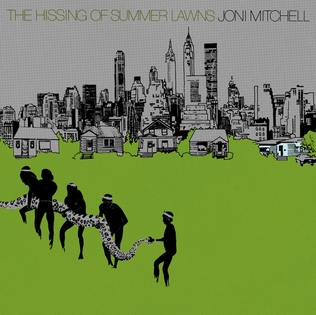
#395: Joni Mitchell - The Hissing of Summer Lawns (1975)


Zack: This is the second of four Joni Mitchell albums on the list. When we started this project, I had no idea who Joni Mitchell was, and so I was skeptical that that was an appropriate number. But then I heard Blue, and album that I listen to maybe once a year and think “Wow, this album is perfect. Why don’t I listen to this more than once a year?” Despite the fact that I’ve only listened to Blue like 3 times, how incredible it is had me pretty excited for The Hissing of Summer Lawns. But the two albums are completely different. Whereas Blue is a pretty straightforward folk album, The Hissing of Summer Lawns draws on a more eclectic mix of genres. There’s a fair mix of jazz here, and it gets a lot more rockish on songs like In France They Kiss on Main Street. The last track, Shadows and Light, even gets a bit experimental by drawing on some looping and electronic-y music. I didn’t like that song, but still. What remains constant is the thoughtful lyrics. I didn’t pick up on a lot of this while I listened to the album, but in reading the lyrics now I can see what intricate stories Mitchell is trying to craft. Between the two, I definitely think Blue is the superior album. But The Hissing of Summer Lawns certainly has its moments, and the way Mitchell pushes the boundaries of folk can be are pretty interesting.
Favorite Tracks: The Hissing of Summer Lawns; In France They Kiss on Main Street; Edith and the Kingpin

Emily: Looking back at where we wrote about Joni Mitchell before, my search brought me to our 200-album award post. I had nominated Blue, our first foray into Joni Mitchell's catalog, for an album that I wanted to return to later on. Since then, I don't think I've actually relistened to it. Perhaps I've heard a song here or there as it popped up on a playlist, but I haven't sat down and played the whole thing since then. Now, after listening to The Hissing of Summer Lawns, it appears I have double the Joni Mitchell albums to return to in the future. For one, I love the title of the album. It evokes such a strong and beautiful image of a quiet street, lined with trees and houses, on a breezy, sunny summer day. And the title fits the tone of the album beautifully as well. It's another intimate take on folk, balanced out with jazz, rock, and a touch of experimentation. As Zack noted, the lyrics deserve a deeper listen to fully understand the scope of the story. I intend to learn more about that story, alongside Mitchell's stories on Blue, when I return to them again.
Favorite Tracks: Harry's House/Centerpiece; In France They Kiss on Main Street; The Boho Dance

Friday, May 27, 2016

#394: The Avalanches - Since I Left You (2000)


Zack: Of the four albums I listened to while working on my prospectus, this one suffered the most form my diminished attention. It faded into the background a bit too easily, unlike Tarkus, and wasn’t compelling enough to get me to go back and relisten, unlike Marcus Garvey. That said, I’m not super sure I would have liked it even if I had been enraptured. I’ve come around a lot on electronic music, but I’m pretty particular. The Avalanches key sound is plunderphonics, which is a made-up word that means sampling a lot. Apparently, Since I Left You has somewhere in the ballpark of 3500 different samples in it, which is a thing that sounds wrong but I can’t refute. This type of music is something I have historically disliked (I can’t emphasize my dislike for Girl Talk enough), but at least when you have that many samples it’s impossible to know who precisely you’re just straight up stealing from so it actually is sort of your own work. Still, it just didn’t have the smoothness of Air or the soulfulness of Daft Punk, so I can’t imagine it would have grabbed me even if I was locked in.
Favorite Tracks: Etoh; Close to You; Live at Dominoes

Emily: Wikipedia decided to call Since I Left You a "plunderphonics" album. That doesn't seem like a real word, and it appears to be essentially the same thing as a mashup. The only difference between this type of album and, say, Girl Talk or The Grey Album appears to be that the insane number of samples draws from less-well-known sources rather than Top 40 pop, rock, or hip-hop. I still consider it a mashup, though, mostly because I really don't want to give the term plunderphonics any credence. Either way, anytime I listen to a mashup now I think about the copyright implications (what can I say, I'm almost a lawyer). Music and copyright is a hot topic right now, with the Blurred Lines/Marvin Gaye case saying that a song with a similar "vibe" to a copyrighted song is infringing, as well as continued controversy over what constitutes the fair use of a sample as a beat or in a mashup and whether the sampled artists should provide compulsory licensing. My guess is that here The Avalanches paid nothing for the samples they used, and it doesn't appear that they got in any trouble for it - regardless of the similarity between the original compositions and the final product. They created something original and new, but only by standing on the shoulders of others. This means of creativity has been embraced by musicians for decades and across genres, but the law hasn't really caught up yet. While I doubt that The Avalanches will get caught up in this evolution, as this album is already over 15 years old, it'll be interesting to see how artists and musicians - both the samplers and the sampled - adapt to a possible new legal regime that overlaps with artistic expression.
Favorite Tracks: Frontier Psychiatrist; Since I Left You; A Different Feeling