Tuesday, July 5, 2011

#107: Devendra Banhart - Rejoicing in the Hands (2004)


Emily: As I was listening to Rejoicing in the Hands, my friend Jen said she was looking for some soft, lullaby-ish music. Luckily, I didn’t have to look (or, rather, listen) too far. Devendra Banhart’s brand of modern folk has a quiet, sleepy quality to it that seemed to fit the bill perfectly. That’s not to say he’s boring, however. The pretty, thoughtful music can peacefully fade into the background, but listen more closely. Banhart’s eclectic style is revealed as the music evolves throughout the album, keeping the listener engaged and wondering what could be coming next.
Favorite Tracks: See Saw; Autumn’s Child; This Beard is for Siobhan

Zack: “So what are you up to tonight, Zack?”
“Not much. Probably just gonna hang around. Oh, and I think I’m listening to a Devendra Banhart album for the blog.”
“Dude! I love Devendra Banhart!”
This is a conversation I had with my friend/co-worker Matt Henry. Unfortunately, I can’t type the way he talks, or else it would be much funnier. But he got me excited to listen to this album. Turns out, excited isn’t really the right way to go into it. It’s all acoustic and very mellow, but with a touch of lo-fi handywork. Kind of like an indiefied Jack Johnson. Rejoicing in the Hands is a great clear-your-head album. It was enjoyable, but not exactly inspiring. At a loss for what to write, I decided to wait until the following day and talk it over with Matt, in case he knew some interesting tidbits about the album that Wikipedia failed to illuminate:
“So I listened to Rejoicing in the Hands Last Night”
“Oh I love that album! Not my favorite but it’s definitely really good.”
“Yeah I thought so too. I’m not really sure what to write about though. Any ideas?”
“You should check out Niño Rojo. That album’s really good.”
“Okay, I will. But that doesn’t really help me with this review.”
“I don’t know, man. Insect Eyes is a pretty creepy song.”
As you can see, that was not particularly helpful. Still unable to think of anything to write, I toyed with the idea of writing an entire review based around how I made it halfway through the album before I realized Devendra was a dude. That didn’t quite seem like enough material, especially since I summed up my whole point in one sentence there. But then it hit me! What if I write a review about how I didn’t know what to write about the album. And here we are.
Favorite Tracks: Fall; This Is the Way; Insect Eyes


Saturday, July 2, 2011

#106: Kiss - Destroyer (1976)


Zack: Oh Kiss. It doesn’t get more gimmicky and ridiculous than them. I mean, they sold coffins for Christ’s sake! That takes commercialism in music to a whole other level. But if you look past the extravagancy and underneath the pounds upon pounds of makeup, there is something that resembles rock music underneath. It’s got all the markings at least. There are a couple foot-stomping hard rock jams, a few over-the-top anthems, and even a ballad. You couldn’t ask for more from a hard rock/metal album. Well, I guess you could. You could ask that it not be Kiss who played the songs.
Favorite Tracks: King of the Night Time World; Detroit Rock City; Beth

Emily: Over the years, Kiss has become less of a band and more of a well-devised marketing plot. The music has taken a backseat to putting their name and signature face paint on all items imaginable. Action Figures? Check. Condoms? Yep. A Kiss casket? Uhh, got that too. That being said, you can’t go into listening to a Kiss album expecting it to be the most innovative musical masterpiece you’ve ever heard. What you do get from Destroyer, however, is a well-produced collection of over-the-top hard rock anthems. They lend themselves to ridiculous performances with fire-breathing men in face paint, a successful formula that’s made Kiss one of the most popular (and lucrative) bands of all time.
Favorite Tracks: Detroit Rock City; Great Expectations; Flaming Youth

#105: Roxy Music - Roxy Music (1972)


Zack: I knew two things about this album going. One: I knew that Brian Eno was the featured synthesizerer. Two: I knew that Brian Eno would later go on to be one of the pioneers and most influential artists of the New Wave/electronic/techno hybrid known as ambient, or music that is specifically designed to fade into the background. With those two things in mind, I thought it safe to assume that Roxy Music would also fade into the background and enhance my Solitaire experience. Well, I regret to inform you readers out there that, for once, I…. gulp…. was………. wrong. Every song reaches out and grabs you. And then it won’t let go. No matter how much you cry and beg for mercy. I was so distracted by its awesomess that I completely forgot about my game of Solitaire. But in the end, I would have to say that it was totally worth it.
Favorite Tracks: Ladytron; 2HB; The Bob (Medley)

Emily: When I think of ‘70s music, alternative certainly isn’t the first thing that comes to mind. But that’s what Roxy Music was doing in 1972. Their self-titled debut begins to bridge the gap between the experimental art rock of the late ‘60s and the glam and punk sounds that came along in the late ‘70s. Drawing from these genres and postmodern pop culture, Roxy Music is an innovative and creative album from an equally innovative and creative band. 
Favorite Tracks: Sea Breezes; Re-Make/Re-Model; If There Is Something

Thursday, June 30, 2011

#104: The Louvin Brothers - Tragic Songs of Life (1956)


Zack: What is there to say about this album that can’t also be said about a vacuum cleaner: it droned a lot and drove my dog crazy. I bet you were expecting me to go somewhere else with that. It plays like the stereotype that any non-country fan (myself included) would expect a country album to sound like. Every song seems to sound like yadda ya -yadda ya - ya ya - yadda ya. I’m told that all those yadda’s were actually words, but I remain unconvinced. Tragic Songs of Life isn’t without redemption, however. For one thing, it’s so old that its stereotypicalness was actually the basis for all future stereotypical country albums! That’s something…I guess.
Favorite Tracks: Katie Dear; In the Pines; Take the News to Mother 

Emily: As I sat down to listen to this album, I mentioned to my dad that I was listening to country music today. His response: “Why do you need to listen to the whole album? It all sounds the same!” Twelve Tragic Songs of Life later, I tend to agree with him. What makes the Louvin Brothers a cut above the rest of the country music that sounds like them, however, is that they were first. They pioneered the traditional, twang-ish sound that we now stereotype as country music. It was totally new to me, but instantly familiar. Case in point: the song In the Pines. It’s a traditional song, but I hadn’t heard of it. As soon as it started playing, though, it sounded completely familiar. It took me a second to realize why: on Nirvana’s MTV Unplugged album, they play a very similar song called Where Did You Sleep Last Night? A quick Wikipedia search commenced, and it turns out they’re the same song. Just goes to show how this whole list is connected, not to mention the history of popular music – no matter how different ‘90s grunge and ‘50s country may seem.                Favorite Tracks: In the Pines; Knoxville Girl; Kentucky


Wednesday, June 29, 2011

#103: Khaled - Kenza (1999)


Emily: I learn something new every single time I listen to an album for this blog. Never is this more apparent than with world music. Though I do enjoy the Putumayo CDs that play on repeat at my job, I had never been introduced to raï before today. For the uninformed and curious, raï is a genre of Arabic, Algerian folk music. Khaled is one of the modern kings of raï. He infuses traditional instruments and melodies with modern Western influences. This sentiment comes together perfectly on my favorite track from the album, a cover of John Lennon’s Imagine. With lyrics sung in Arabic, Hebrew, and English, Khaled takes a song that has been covered a million times over and still makes it his own, fusing raï with pop and West with Middle East.
Favorite Tracks: Imagine; Aâlach Tloumouni; El Aâdyene

Zack: We were well overdue for a “world music” album, but looking at the list is so intimidating that we kept pushing it off. Finally, the day arrived when we could not possibly postpone any longer, and we picked (mostly by random) Kenza by Khaled. There was really very little thought put into it, but looks like luck was on our side. Kenza was an enticing blend of different genres, instruments, and cultures. It has a uniqueness that even managed to shine through while covering the iconic song Imagine by John Lennon. Certain songs are so big that for an artist to really make it their own in any way that isn’t terrible always catches me off guard. Kenza, after a while, was so impressive that I think I may not wince at the thought of reviewing the next world album. Or maybe I’ll just leave it at a slight grimace. Baby steps.
Favorite Tracks: Imagine; Leïli; E'dir E'sseba

Monday, June 27, 2011

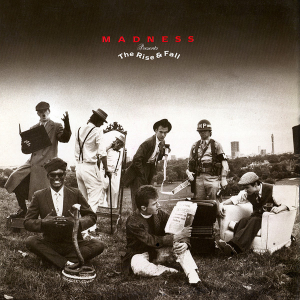
#102: Madness - The Rise & Fall (1982)


Emily: Madness is perhaps best known for a little song called Our House. Start humming a few bars, and the upbeat tune will be instantly recognizable from dozens of commercials and TV shows. What most people don’t know, however, is that Madness had a lot more to say. Although never released in the US, The Rise and Fall was one of Madness’ most successful and acclaimed albums overseas. They take two-tone ska beats and mix them with different styles and influences, from jazz to the sounds of India. Throw in a bit of politicizing over the bouncy beats, and what do you get? A thoroughly enjoyable album that is more than just a one-hit (one-house?) wonder.
Favorite Tracks: Mr. Speaker Gets the Word; Calling Cards; Our House

Zack: Our House is such a big song that not having heard of it is pure, well, madness. After that point, my knowledge of the band was somewhat limited. I knew that they walked a fine line between pop and ska, and that was enough to peak my curiosity. When it actually came to listening to the album, I felt that this ska-pop description wasn't nearly accurate enough. For one thing, they tended more towards pop than anything else. Furthermore, the "ska" description was a bit misleading. They infuse their pop sound with multiple genres, one of which is ska. That makes them about as much a ska band as any musician who ever went "I think this song needs more cowbell. And maybe a little trumpet too." As far as pop albums go, though, this extra complexity added a pleasant depth that I really appreciated. I think more pop artists should introduce bangin' sax solos intro their songs. Maybe "bangin'" wasn't the right adjective there, but I'm sticking with it. Anyways, I wish more of the music that makes its way onto radio sounded like Madness. Here's hoping that 30 years of trends suddenly reverse themselves!
Favorite Tracks: Madness (Is All in the Mind); Our House; Calling Cards

Monday, June 20, 2011

#101: Bruce Springsteen - Born to Run (1975)


Zack: In New Jersey, speaking ill of Bruce Springsteen is a serious crime. In southern NJ specifically, where I hail from, it’s actually punishable by the death penalty. We take The Boss very seriously around here, thank you very much. Among his many great works, many argue that Born to Run is his best work. It’s not difficult to see why. It’s one of his most iconic albums. It has one of his most iconic songs on it. It even has an iconic cover. It has everything you need for a great experience from one of the most iconic musicians ever. But it has something else, on top of the greatness that oozes out of Bruce. It has an incredible, although understated, performance by Clarence Clemons on saxophone. The songs simply wouldn’t have worked without The Big Man blowing away in the background. Unfortunately, after 69 years that included a remarkably successful music career, he passed away due to complications of a stroke two days ago. Truly, the world lost an incredible musician and person that day. Clarence Clemons, you were born to play the tenor sax, and you will be missed.
Favorite Tracks: Born to Run; Jungleland; Thunder Road 

Emily: Bruce Springsteen is one of those iconic American musicians. He’s been making music for 30+ years, is always touring, and just knows how to craft great rock songs. This album is perhaps one of the earliest (and best) examples of Springsteen’s musical prowess. There’s powerful rock guitar and vocals from Springsteen himself, rounded out by the diverse instrumentals of the E Street Band. It’s a formula that’s built for playing loud, singing along, and seeing in concert – arena rock at its best.
Favorite Tracks: Jungleland; Born to Run; Tenth Avenue Freeze-Out